Diving - My Continuing Adventures underwater
Adventures in Mexico
In January 2026, Mandy and I set off for a holiday in Mexico, somewhere we'd talked of visiting for a long time.
You can read the full report here, if you're interested, but one of my ambitions in visiting Mexico was to do some diving in the Cenotes.
I had done some research before the trip and, initially, identified two that I wanted to dive, Dos Ojos (Two Eyes) and El Pit (The Pit).
However, talking to Caroline from the dive club, who had visited the previous summer, I liked the idea, especially, of 'Dreamgate', about as close to a cave dive one can do without proper cave diving training, so I booked an extra day, combining Dreamgate with 'Carwash' which sounded like a good choice, too.
I selected The Cenote Guy as the operation to dive with and this turned out to be an excellent choice, with highly experienced and fun guides.
Cenotes - Dos Ojos and El Pit
The first day of diving with The Cenote Guy started with a taxi ride to the Wallmart in Playa Del Carmen. This was because a) it was easy to direct a taxi to and b) just across the road from the dive operation I was to meet them at.
As I arrived a little early, I wandered into the shop, looking for a gadget to read an SD card via a USB-C connection, but I couldn't find one and headed to the corner the information I had directed me to.
On arriving, I found 3 black pickups being loaded with cylinders and other gear. A friendly, bearded Frenchman greeted me and introduced himself as my guide for the day, Alexis.
After a little while, we were ready to go and I climbed into the pickup with two Americans, a French guest diver and Alexis, stopped briefly to pick up lunch (included in the cost) and headed out of town down the road towards Tulum.
The drive was quite relaxed and watching the traffic, I started to think that I wouldn't find driving in Mexico stressful and so it proved when we rented a car in our second week.
We took the turn to the 'Dos Ojos' centote park from the main road and arrived at a kiosk, where we paid the entrance fee and drove in.
There we assembled our equipment (provided by The Cenote Guy) and walked down to the Cenote to get a safety briefing (that would apply to all dives) and a site briefing, obviously site specific.
The main thing in the safety briefing were don't pass any signs that say STOP, follow the yellow 'cavern' lines, not the white 'cave' ones and to stay in our position in the team, each of us allocated a number to determine where in the queue we were to dive and under strict instructions to remain in.
That done, we kitted up and headed back down to the tiny pool, under an overhanging rock.
At first sight, it looked as if there was nothing but a shallow pool with no way to dive, but when we stepped in, we could see a darker section of water under the overhang and, as we descended, we could see it extended and opened up into a larger cavern.
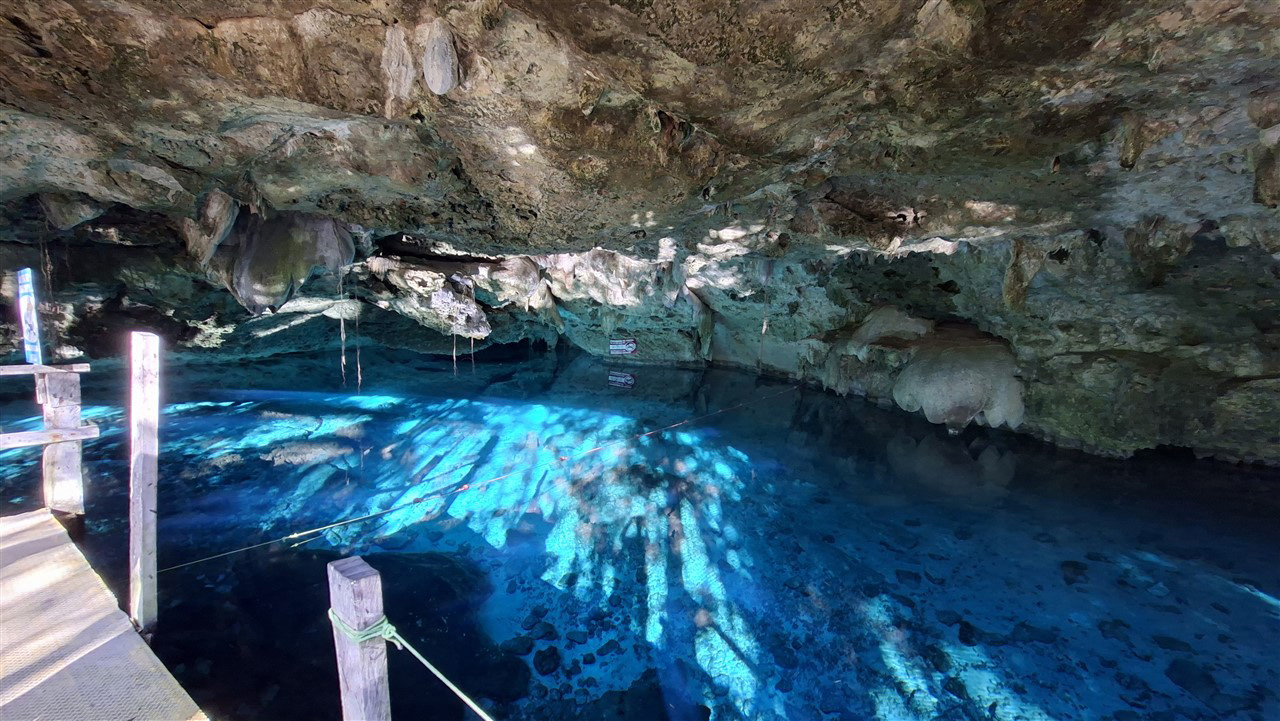
The entrance to Dos Ojos looks like a small pool.
After discussion we chose to dive the, longer, Barbie Line route, although there is a second route, called the Bat Cave (I believe there are bats in an air pocket).
Dropping down I could see the vis was incredible. Completely devoid of sediment or algae, it was easy to forget that you were underwater and more than once on the dives, I recall thinking "Mandy would like this, we should come back with her" before remembering it was only being able to scuba dive that made it possible to be there!
The route passes through various chambers, with stalactites and stalagmites, sometimes meeting to form columns, at a couple of points coming close to the other 'eye' (Dos Ojos is named as such as, from above, it's said to look like two eyes into the underworld), where light floods in.
My first cenote dive, the Barbie line at Dos Ojos
At one point, a Barbie doll is tied to the line being mauled by a hungry alligator, but we didn't see any of those on any dives (some cenotes do have them, apparently), but I wasn't too unhappy about that.
The darkness, for most of the dive, which lasted 53 minutes and reached the dizzying depth of 7.5M, was complete, but, even on medium settings, our small torches did a great job of illuminating the area to a considerable distance ahead.
I never felt claustrophobic on the dive (I didn't expect to, being happy inside wrecks, but you never know), just marvelled at the underwater environment and landscape.
The final moments of a cenote dive are always great as, whilst you don't really want it to end, you do usually get a lovely light show as you return to the cavern exit.
We dekitted, had a few between dives snacks and then headed off to the nearby 'El Pit' which is in the same park.
'El Pit' (The Pit) is renowned for its depth and couldn't have been more different to Dos Ojos.
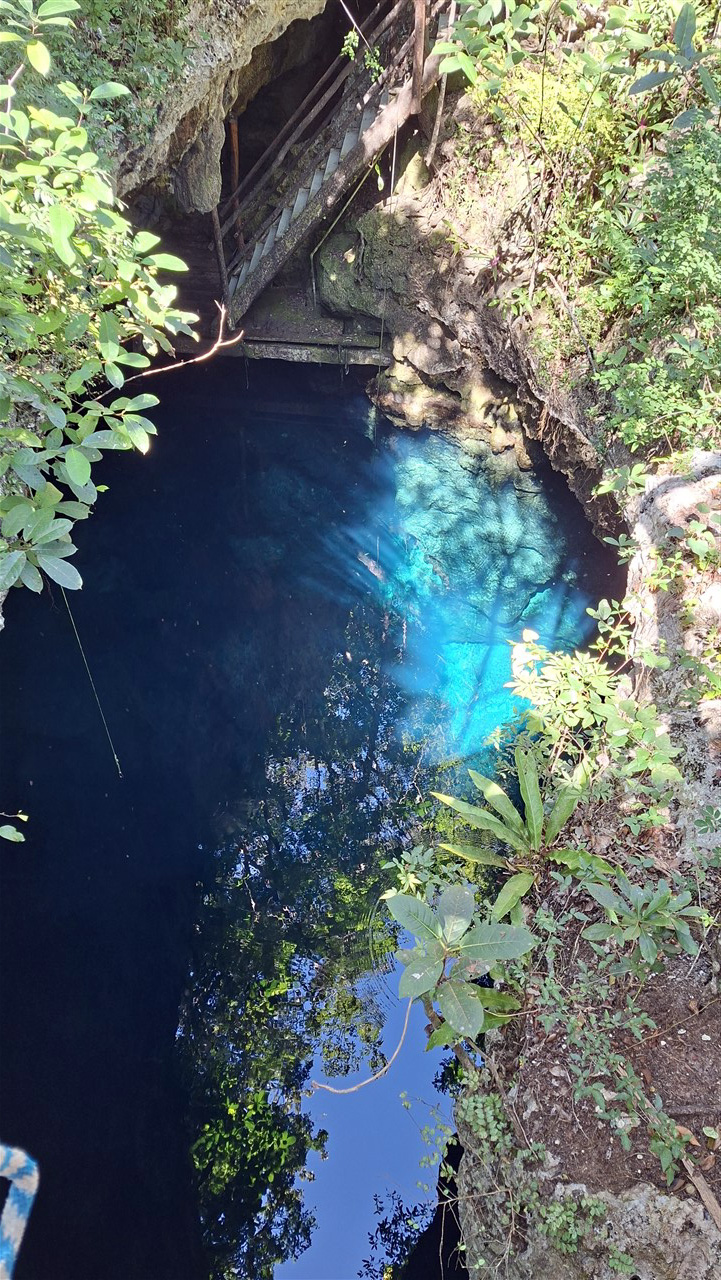
'El Pit' viewed from ground level, it's quite a climb down before you even reach the water.
We descended down a staircase (the Americans elected to have their kit lowered on a hoist) to the water some metres below. This a cenote where the 'collapsed ground over a cave' nature of a cenote is very apparent.
Below the surface, the water was again crystal clear and we could see both down and across many tens of metres (Alexis claimed vis in the Cenotes is 100M).
We swam across the cenote to the edge and started to descend, ultimately reaching around 25M, passing through a halocline, where fresh and salt water meet and the water shimmers making everything seemingly blurry, including gauges and dive computers. We were told about it, but it's still an unusual experience!
A video of the dive into "El Pit"
We explored the site, descending down until we were just above the Hydrogen Sulfide Cloud, which was at a surprising shallow 27M (usually it lies at 35-40M) and seeing some Mayan pottery discovered in the cenote and placed on a ledge.
El Pit actually reached down to over 100M and is one of the deepest cenotes in the Yucatan.
While it initially seemed it may be a little dull after the rich cavern landscape of Dos Ojos, nobody came away disappointed with our dive in El Pit. The contrast between the two sites was actually part of the appeal and I was eager to see more cenotes.
If I'd not booked a second day already, I'm sure I would have done so after these two dives.
Cenotes - Carwash and Dreamgate
It was a few days later that I was back to meet up with The Cenote Guy crew again. I saw Alexis, but my guide for the day was another Frenchman, Sebastian.
I was the only diver heading out from Playa Del Carmen, but we were to meet a Swiss woman and Polish man in Tulum.
The drive down was easy, but while Adriane was soon there to meet us, Paul was late. We waited for him though and, apparently, he had called to say he was going to be a little late and it didn't really affect the day.
'Carwash' (Mayan name, Aktun Ha) was how I imagined cenotes to look.
Only a few miles from Tulum, we were greeted by a clear, blue lake, surrounded by greenery and trees. Looking into the water, aside from many divers undertaking cave diver training, I could see shoals of fish and even terrapins swimming!
It looked lovely.
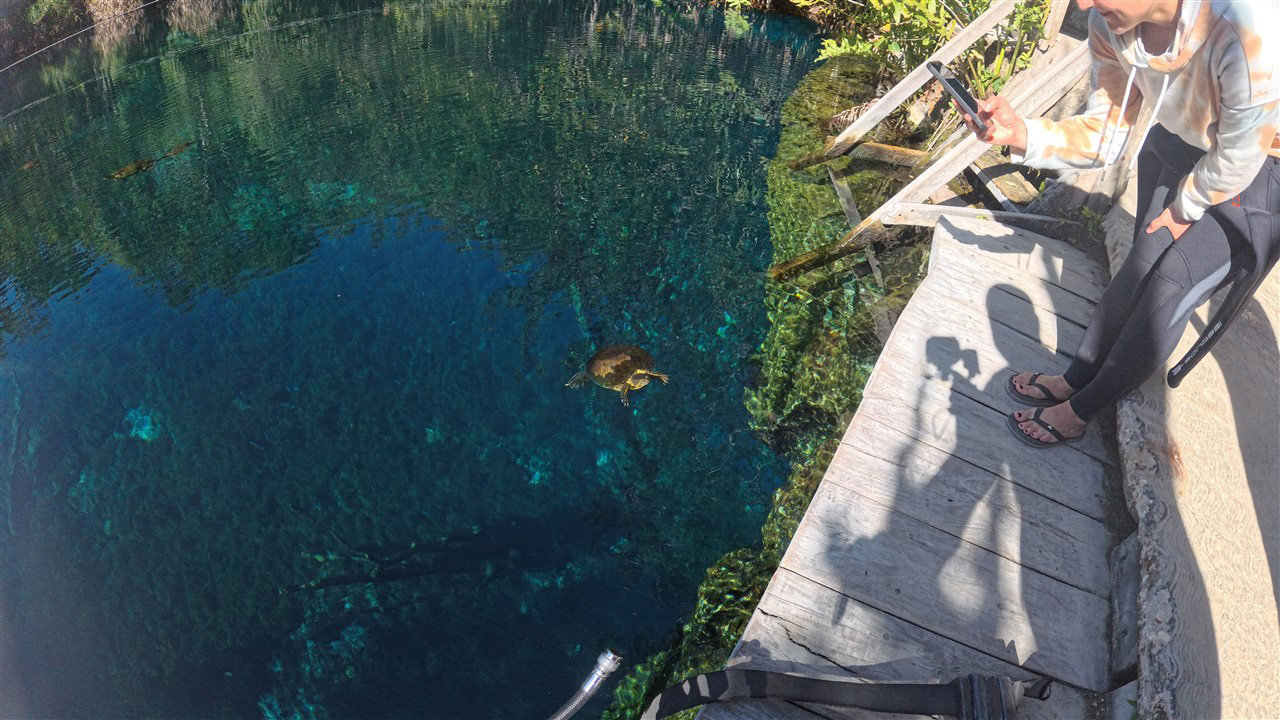
'Carwash' features lots of life and is very picturesque.
The dive itself was possibly the least exciting, but one of the most attractive. Either end of the cenote there is a cavern area, leading deeper into a massive cave complex.
We explored the cavern line in one end, which was similar in its landscape to Dos Ojos, and then crossed the lovely clear water of the open air part, to reach the cavern area at the other end.
The dive at 'Carwash' cenote
I could have spent hours just floating around the open area as the light flooded in, fish small and reasonably large swam past alone or in shoals and the terrapins travelled up and down from the surface to grab some air before diving back down in search of food.
It was quite magical, not a word I'm prone to using, but it was lovely to dive there.
We ate some lunch after our 56 minute, 15M dive and then packed the pickup and headed back along the main 307 highway (which runs along the coast, connecting Cancun to Playa Del Carmen, Tulum and beyond) before turning down a bumpy track.
Even in the pickup, with its elevated suspension, the road was rough, there was no way a normal road car would have managed the road, in my opinion, but it led to a delightfully secluded spot.
If I'd thought Carwash was picturesque, 'Dreamgate' was next level!
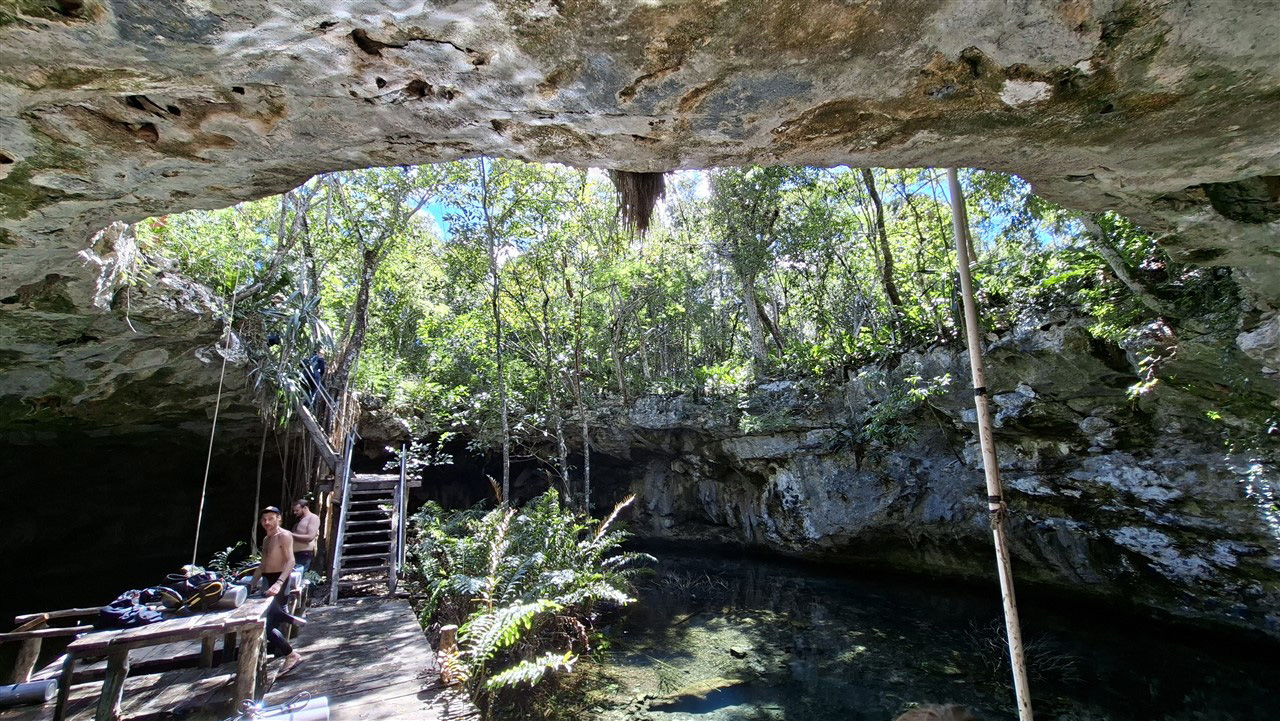
Access to Dreamgate is tricky, but it rewards both above and below the water.
It's next level in terms of difficulty, too, with narrow passageways and a significant distance from light on much of the dive making this a grade 3 (or even 4 according to some internet sources, but I'm sure the sign said 3) cavern, only accessible by proven, experienced cavern divers (Sebastian gave Paul some advice on buoyancy at Carwash because, with less than 40 dives completed, he looked unable to completely control his buoyancy there, but he obviously took it on board as he had no problems in Dreamgate, luckily).
Unlike Carwash, you descend into Dreamgate before reaching the water, lowering your equipment down a hoist as the staircase is inadvisably steep to walk down with a cylinder on, where a wooden walkway extends over a beautiful pool of blue water and lush green vegetation.
As at Dos Ojos, it is hard to see from the surface where you could dive, it looks like some shallow pool, but once below the surface you see that the cavern opens up in a similar way below the rocks.
Sebastian had explained that there were two routes around the site, but we would complete both, coming back to near the surface on the opposite side of the cenote opening before circling around the second loop and exiting in the opening again.
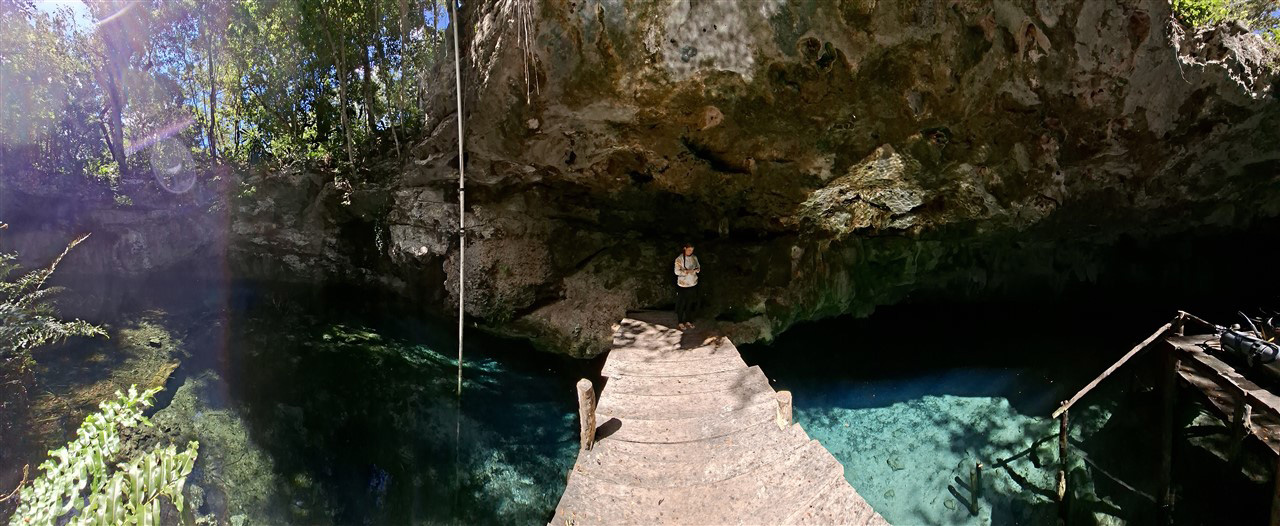
We entered on the far right of this shot, looped around to pass through the open water on the left and then emerged on the right of the walkway in the centre of the photo.
We set off and went below the rock into an open area fully of columns, stalactites and stalagmites, but on a scale and extent unseen at the other sites.
In places it was reasonably tight, but not as bad as I thought it might be from Caroline's comments and other reports online. That said, for much of the dive there was no obvious sign of light and I still cant really see how this wasn't a cave dive (someone said that it becomes a cave where there are parts where two divers cannot pass side by side and there was only one small section where I recall that being true - You can see it near the end of my video).
At one point, Sebastian demonstrated how some of the stalagmites glowed like lava lamps if a torch was applied to them and at another point we bounced our torchlight off of air pockets on the roof to give a 'disco light' (Sebastian's phrase) effect on the floor.
Aside from the wonderful landscape, a notable element of Dreamgate is an air pocket where you can surface and breathe the air, although there is no open space above you. Interestingly, though tree roots descend from the roof into the water below and a ladder is visible ascending up into the ceiling. This, apparently, is the escape route for any panic-stricken diver in the cenote!
None of us fell into that category, so we traversed the open air, with light flooding in again and continued into the second loop to traverse all the way to the end, giving a total dive time of exactly 1 hour according to my dive computer (and a maximum depth of only 6.1M!).
Diving the Dreamgate cenote (or half of it, anyway!)
It was definitely the best dive of the 4, although any of them in isolation would have been rated extremely highly.
It almost seemed that each dive instantly became my favourite!
Frustratingly, I ran out of memory card space just as we finished the first section, so I have no footage of the second part, but equally it meant I could just focus on what was around me, rather than filming what I saw as well, so maybe it was the perfect way to dive the two parts.
And so, my cenote diving experiences came to an end, we dropped the other two divers at Tulum and drove back to Playa Del Carmen, where I settled my bill and took a taxi back to the hotel.
The Cenote Guy operation was great and I was so happy I'd dived with them. Both guides were excellent and we did good, long dives in all the cenotes. Paul commented that his experience with another operation was a far shorter dive and Sebastian commented that many other would not exceed 45 minute dives at most.
Overall, it had been great, I'd loved every cenote and each one had offered something different, but I was very glad that Caroline had dived Dreamgate and I had elected to add it, because it was something really special.
Sea Diving at Playa Del Carmen.
I had really only planned to cenote dive initially as this wasn't just a diving holiday for me, but then I discovered our visit would coincide with pregnant Bull Sharks being in the area, where they come to give birth each year.
This was too good an opportunity to ignore, so I booked a couple of dives with Dressel Diving who operate from the hotel we were staying in.
There was some confusion over when I wanted to dive and then weather prevented me diving another day, so it wasn't until the Tuesday of our second week that I finally did my sea dives in Mexico.
Diving with the Bull Sharks is considered 'advanced' diving, so they, not unreasonably, insist even experienced divers do a dive elsewhere with them first, just to see how 'experienced' you really area.
My first dive was on a reef called Shangri La. There were probably 20 divers on the boat, including a professional photographer and a number of guides, so things were quite busy when we dropped in.
One of the other guest divers had picked up my gauge mask not noticing the twin lenses, but luckily one of the guides found it before we went in!
I was assigned a young woman to dive with, she was OK, but seemed quite distracted during the dive, but I also kept close to the guide, Iris, a Belgian woman, as I hoped she'd spot things I may miss alone.
The reef dive
The reef was quite a shallow rock shelf really, but we did spot a decent number of fish, including a Stone Fish (The guide coming into play there),quite a lot of Green Eels, one a decent size, the usual grunts and other colourful reef fish and even a stingray, right at the end of the dive.
The dive wasn't deep (11M maximum depth) or terribly long (47 minutes), but many of the divers looked pretty inexperienced and I was really only there to get a tick in the box for the Shark dive.
Not a total waste of time by any means, but not a remarkable dive, either.
I returned around 1PM to get ready for the Bull Shark dive.
We headed out on the small boat again and were under strict instructions to stay together, not swim around in the open and ascend as a group at the end of the dive.
We were advised to drop down to the seabed and then lie or kneel for a while in the hope that we'd see a shark and then move onto another spot.
As soon as we dropped in it was clear that there was a raging current, on a par with those at Darwin or Wolf, running, but nowhere to shelter from it (unlike the Galapagos) or anything substantial to hold onto.
Everyone was tumbling, sliding or just being swept away. It seemed that they schedule dives by the clock, not according to the tides, which seemed a fundamental mistake to me!
Eventually we managed to find somewhere in only a strong current, but a good 15 minutes had passed in this chaos and it seemed unlikely we'd see anything.
Then, off to my left, I saw the professional photographer pointing and turned my head and there, only a few metres away was a large Bull Shark swimming past us.
It swam on and into the blue and few moments later the guides moved on.
At least we'd seen one Bull Shark, although my hopes of getting some close ups with my stills camera were stymied as I needed one hand at all time to hold my position and I considered it fortunate that I was able to get a little footage with my AcePro action camera, even if the Shark does seem further away than it actually was.
A video of the Bull Sharks
Luckily we spotted another two Bull Sharks before we got dangerously low on gas, so things went reasonably well in that respect, even if the scheduling of the dive seemed unwise to me.
They don't, as some operations do, feed sharks, which is an action which is sometimes said to lead to sharks associating people with food and leading to attacks, so that is definitely a plus, but I wouldn't say I was particularly impressed with them as a dive operation.
The important thing, though, was that I had seen Bull Sharks and lived to tell the tale, even if the dive operation seemed a greater risk than the sharks.